

Wednesday, 29 January 2014
Oooops how embarrassing is that!
Whist we were discussing the problem we have with the engine (the header tank keeps emptying once the engine has cooled) with the boat builder we asked about having drawers put in under the kitchen cupboards where the kick boards are. We knew we had discussed it during the build, but were both sure we had opted not to have them done. Bob said he was sure they were done as he ordered the parts and sure enough when we got to the boat with him this is what we found!
Unless you know where the hidden silver handles are you would not know they were there, which we patently didn't!!

Saturday, 18 January 2014
Inside a lock
Saturday 18th January 2014
Tardebigge Top Lock Open Day
Major work is being undertaken on the large top lock (the largest narrow lock in the country) at the top of the Tardebigge flight (also the longest flight in the country)!. We walked along the tow path last week and could see the extent of the infrastructure round the lock. Some fairly major preparation had to be done before work could commence.
The pound below the top lock is very long (700 metres). It all had to be drained and any fish (23,000 of 24 different species) left were netted and moved down to other pounds and deep water. Apparently it is one of the 'healthiest' pounds that has been drained in recent times. Even the experts were surprised by the number and variety of fish. You can see from the photo below (at lock 57 looking northwards towards lock 58 - the "Top Lock") why narrow boaters are often referred to as 'Ditch Crawlers'.


The fish were not the only ones who had to move - there are several residential boats on the non tow path side and they have lost their water temporarily. The chickens are still there, but the boats have gone.


They are safely moored above the top lock for as long as it takes.


First sight of the lock

Messy work


To the open day itself - one I am afraid I missed as I am under the weather and decided I should keep my bugs to myself, but Chris went along as planned to visit the bottom of the lock and he stayed for the morning to help with car park marshalling and talking to visitors hoping to drum up a few more volunteers. I am hoping Chris will add a postscript with first hand words of wisdom in due course.. For me the pictures are very interesting - I have certainly never seen an empty lock and I am sorry I missed it in the flesh. Apparently the bricks at the bottom are standard bricks and are as old as the lock (over 200 years). The bricks above the lowest water line are engineering bricks. Our daughter and grandson (G aged 5) went along this afternoon and despite a wait of 1.25 hours (they had tickets) they both enjoyed the experience. I gather the hard hat and high viz jacket were a big hit with G!!


There is little more to add to what Jennie has already written; the photos (a mix of J's, G's mum and a few of mine). All I would say is that if you have not seen inside a drained lock (not necessarily one of the largest ones!) and the opportunity is presented to visit, do go ahead. Bearing in mind that the engineering is probably approaching 200 years of age (OK, routine maintenance has helped), they are quite magnificent structures and give one some idea of the scale of what these early transport engineers were undertaking. During my time today at Tardebigge I was made aware of the fact that before the canals, most towns of any size and importance were found only where natural water aided transport, i.e close to the sea or on major rivers. The canals started the change to that, and then the railways, finally leading to the motorway network etc. of today.
Wednesday, 16 October 2013
A Plane for a change - Dornier Do-17Z
Tuesday 15th October
Completely off topic - planes not boats, but an occasion worth noting and mainly so Chris's brother in New Zealand can see the pictures as he is the one who has done all the research into their father's time in the RAF.
Yesterday Chris and I were invited along to the RAF Museum at Cosford for the unveiling of the German bomber (Dornier Do-17Z) that was lifted from the Goodwin Sands back in June. This is a link to an article in the Sunday Telegraph for some background if anyone is interested and missed it at the time.
Chris and Alan's father (Fred Gash as mentioned in the article) was a rear gunner on Defiants and he and his pilot (Desmond Hughes) were in action that day and claimed a couple of hits, but who actually shot the plane down will probably never be known.
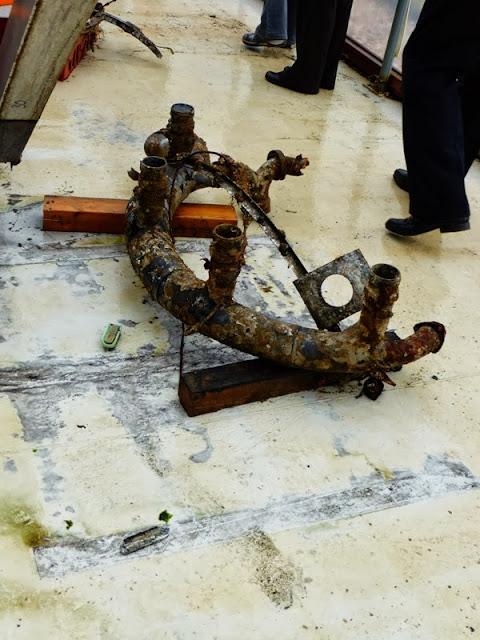
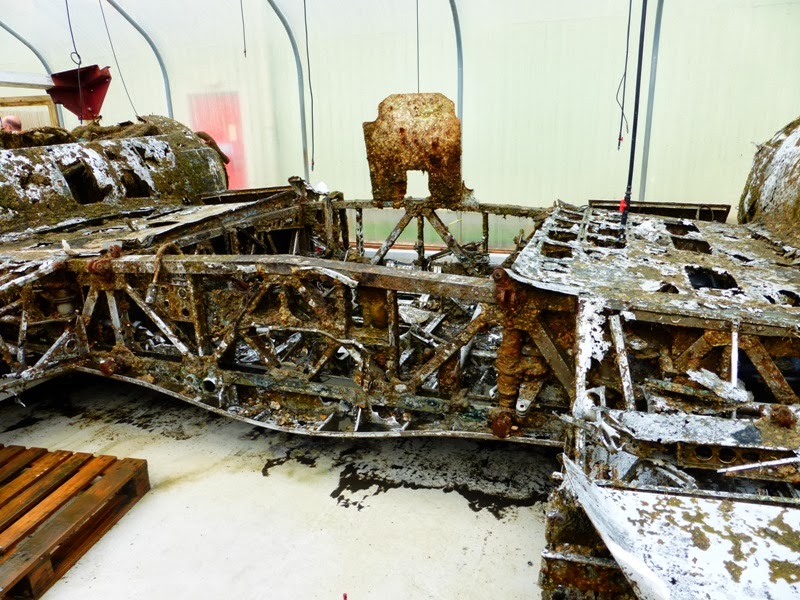
What is amazing is how well she has survived after 70 decades on the sea floor. The day started with a chance to wander round and watch some of the volunteers and apprentices cleaning various bits and pieces of the plane. Such detailed work and more patience than I have required for that job. I am afraid that I did not take any photos, but the end results are astounding. I have scanned in some pictures from the programme which give an idea how good they look after they have been worked on. We saw these pieces and they are even more impressive in the flesh.

We had a chance to mingle and chat - we met the son and one of the grandsons of Desmond Hughes amongst others. Then there were a few speeches. Peter Dye the Director General of the RAF Museum just welcomed everyone, filled in the background and set the scene. Next was Kathy Gee - a trustee from the National Heritage Memorial Fund who helped fund the rescue of this unique plane. She actually ended her tenure at the end of September, so this was her last ever 'duty' for them. She said it was a project they really wanted to succeed and were delighted to help with the funding. Then it was the turn of Tracy Spaight from Wargaming.Net - not a company that might spring to mind for a project like this, but he explained that, as a company, they are always very keen to get the historical details right on all their computer/video games, so the company was another benefactor who has helped this project to get this far. Finally it was Conrad Dornier the grandson of the man who designed the Dornier planes. He was actually a Belgian, but lived on the border and ended up working in Germany. He was very disillusioned with the way things were going around the time of WWII and stopped actively producing new planes as he did not want to help the Nazis. I found his speech particularly interesting and quite moving.
Then we were let loose! And oh what a beautiful sunny afternoon - they were so lucky as Monday and today have been horrendous - really wet and wild.
The plane is in two parts and is kept in separate hydration tanks - this was our first view and just check out that sky! You might like to note that the man in the foreground is Chris - a little smarter than his usual boating gear!! Chris has just proof read this and his only comment - his hair is not as white as the man in the picture below! He still has the odd hint of brown in the front and is not used to seeing himself from behind!
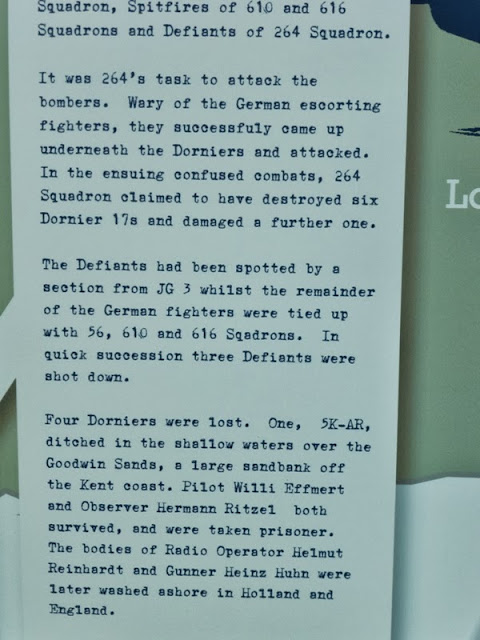
 The following are some pages from a booklet we were given that gives a lot of detail in a far more concise way than I can:


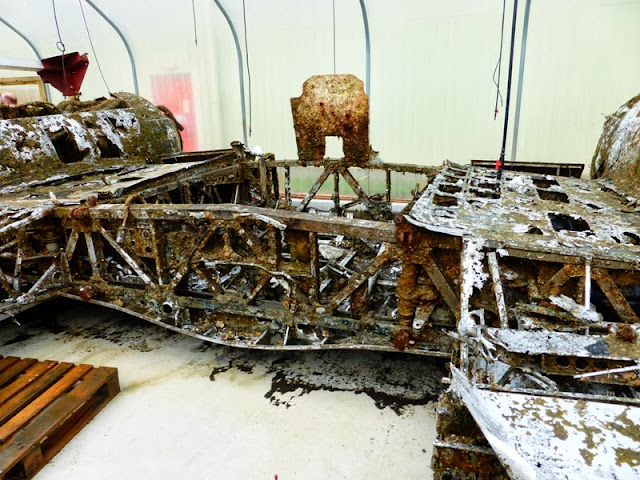
 Right onto the photos - there are a lot of them! This first section is the fuselage and tail plane hydration tunnel:




 I am glad I have not got to do this jigsaw puzzle!

 Now we are on to the other tank - the wings, engine nacelles and main wheels




 There is still a lot of work to do over the next couple of years. We are planning on keeping an eye on things and hope to take the family in around a year's time.
Outside the tunnels was a space for displays and information:




 All in all a very interesting day.
Completely off topic - planes not boats, but an occasion worth noting and mainly so Chris's brother in New Zealand can see the pictures as he is the one who has done all the research into their father's time in the RAF.
Yesterday Chris and I were invited along to the RAF Museum at Cosford for the unveiling of the German bomber (Dornier Do-17Z) that was lifted from the Goodwin Sands back in June. This is a link to an article in the Sunday Telegraph for some background if anyone is interested and missed it at the time.
Chris and Alan's father (Fred Gash as mentioned in the article) was a rear gunner on Defiants and he and his pilot (Desmond Hughes) were in action that day and claimed a couple of hits, but who actually shot the plane down will probably never be known.
What is amazing is how well she has survived after 70 decades on the sea floor. The day started with a chance to wander round and watch some of the volunteers and apprentices cleaning various bits and pieces of the plane. Such detailed work and more patience than I have required for that job. I am afraid that I did not take any photos, but the end results are astounding. I have scanned in some pictures from the programme which give an idea how good they look after they have been worked on. We saw these pieces and they are even more impressive in the flesh.

We had a chance to mingle and chat - we met the son and one of the grandsons of Desmond Hughes amongst others. Then there were a few speeches. Peter Dye the Director General of the RAF Museum just welcomed everyone, filled in the background and set the scene. Next was Kathy Gee - a trustee from the National Heritage Memorial Fund who helped fund the rescue of this unique plane. She actually ended her tenure at the end of September, so this was her last ever 'duty' for them. She said it was a project they really wanted to succeed and were delighted to help with the funding. Then it was the turn of Tracy Spaight from Wargaming.Net - not a company that might spring to mind for a project like this, but he explained that, as a company, they are always very keen to get the historical details right on all their computer/video games, so the company was another benefactor who has helped this project to get this far. Finally it was Conrad Dornier the grandson of the man who designed the Dornier planes. He was actually a Belgian, but lived on the border and ended up working in Germany. He was very disillusioned with the way things were going around the time of WWII and stopped actively producing new planes as he did not want to help the Nazis. I found his speech particularly interesting and quite moving.
Then we were let loose! And oh what a beautiful sunny afternoon - they were so lucky as Monday and today have been horrendous - really wet and wild.
The plane is in two parts and is kept in separate hydration tanks - this was our first view and just check out that sky! You might like to note that the man in the foreground is Chris - a little smarter than his usual boating gear!! Chris has just proof read this and his only comment - his hair is not as white as the man in the picture below! He still has the odd hint of brown in the front and is not used to seeing himself from behind!


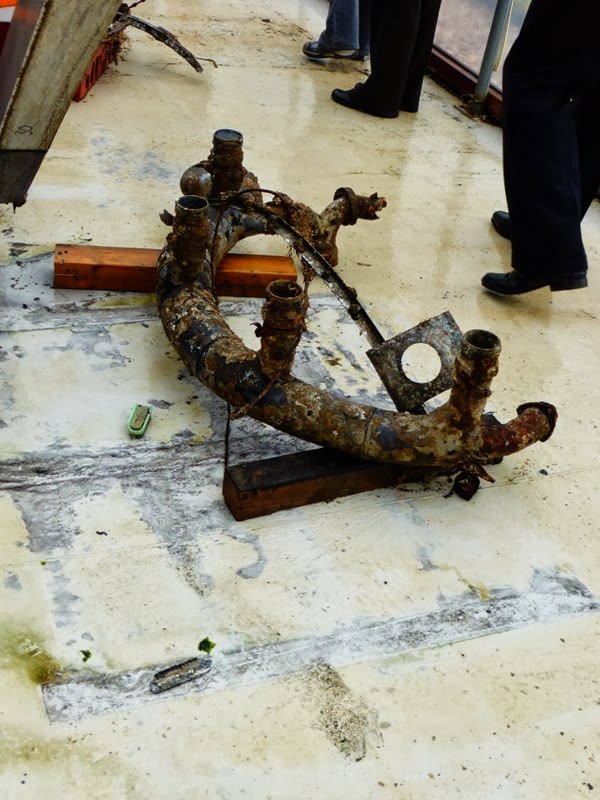




We were both amazed at how intact the propeller is


More jigsaw puzzles!

Outside the tunnels was a space for displays and information:
This area had an audio visual presentation


The story in three parts


The route, field of combat and site of the ditching on the Goodwin Sands


Subscribe to:
Posts (Atom)